Why Most People Never Build Anything That Survives Them

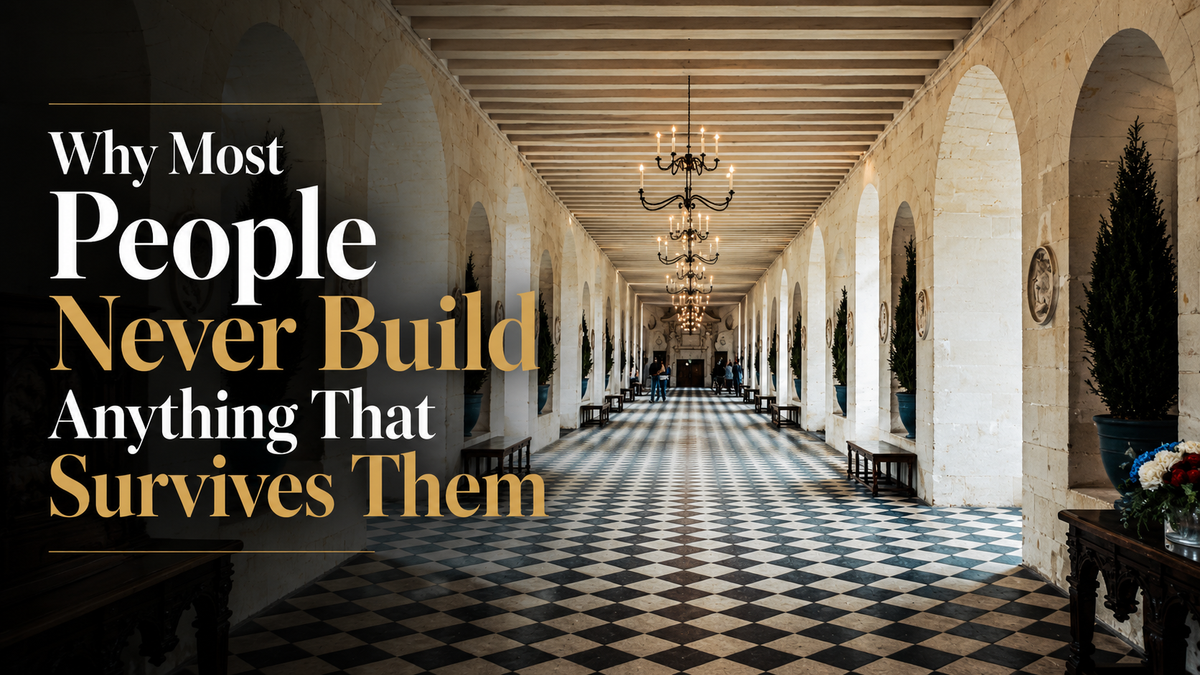
One of the ideas I have returned to repeatedly over the years is that ambition and durability are often confused for one another.
At first glance they appear closely related. The people who seem most likely to build meaningful things are usually those with energy, urgency and visible drive. They set goals, move quickly and operate with intensity. Modern culture celebrates this approach because intensity creates visible movement, and visible movement is easy to mistake for meaningful progress.
But over time I have become less convinced that ambition alone explains why some people, families, businesses and institutions continue creating value long after the original excitement disappears.
Increasingly, I think many people do not fail because they lack effort or vision. They fail because they confuse intensity with systems.
That distinction matters.
Intensity can produce action. Systems produce continuity.
One of the clearest examples of this can be seen in the way we think about goals. Goals have become almost unquestioned in modern performance culture. Revenue targets, growth plans, strategic objectives, personal milestones and long-term visions all occupy significant attention.
Goals matter because they create direction.
But goals by themselves rarely explain durable outcomes.
A goal tells us where we hope to arrive. It says very little about the repeated behaviours, decisions and structures required to arrive there consistently.
That difference becomes increasingly visible over time.
Businesses rarely survive because of one extraordinary quarter. They survive because decision-making becomes repeatable, knowledge becomes transferable and operating systems become stronger than individual personalities.
That is one reason organisations such as Toyota became known for process discipline rather than depending on individual performance alone.
Reference:
Toyota Production SystemThe same principle appears in long-duration capital allocation. Berkshire Hathaway’s success has never depended on reacting faster than everyone else. Its strength has come from decision frameworks, patience and disciplined capital allocation applied repeatedly over time.
Reference:
Berkshire Hathaway Shareholder LettersFamilies rarely remain healthy because of one important conversation. They remain healthy because values become habits and expectations become embedded into daily life.
Wealth rarely compounds because of one successful investment. It compounds because allocation becomes disciplined, governance improves and decisions remain consistent across changing circumstances.
The visible result attracts attention.
The invisible structure usually created it.
This may also explain why motivation is often overestimated.
Motivation feels powerful because it creates momentum. It creates the feeling that meaningful change is finally beginning.
But motivation is unstable.
People often design plans around exceptional days and then become disappointed when ordinary days return. They build expectations around emotion instead of building environments capable of producing outcomes repeatedly.
Systems assume something more realistic.
They assume inconsistency.
They reduce dependence on energy.
They create conditions where progress remains possible even when motivation weakens.
That idea becomes increasingly important when we begin thinking about legacy.
Legacy is often spoken about as reputation or remembrance. But I have become increasingly convinced that legacy may be a structural concept before it becomes an emotional one.
Legacy asks different questions.
What continues when attention moves elsewhere?
What remains when leadership changes?
What survives when the founder steps away?
Those questions reveal whether something has become durable.
Because if progress depends entirely on one person, continuity has not yet developed.
If every decision requires one individual, the system remains fragile.
If value disappears the moment energy disappears, structure never existed.
This does not reduce the importance of people.
People matter deeply.
But perhaps one of the highest forms of stewardship is building structures capable of continuing to create value beyond our direct involvement.
That idea changes how we think.
Instead of asking only:
What outcome am I trying to achieve?
We begin asking:
What process consistently produces that outcome?
And perhaps the more difficult question becomes:
What would continue if I stepped away?
That question applies to business.
It applies to family.
It applies to wealth.
It applies to leadership.
Because ultimately, the objective is not to become indispensable.
It is to build structures capable of continuing long after intensity fades.
Things that survive rarely do so accidentally.
They survive because someone intentionally designed for continuity.
— Phillip J. Mostert
♾️
Further Reading
• Atomic Habits — James Clear
Atomic Habits — James Clear• The E-Myth Revisited — Michael Gerber
The E-Myth Revisited — Michael Gerber• Good to Great — Jim Collins
Good to Great — Jim Collins