Why most experts stay invisible

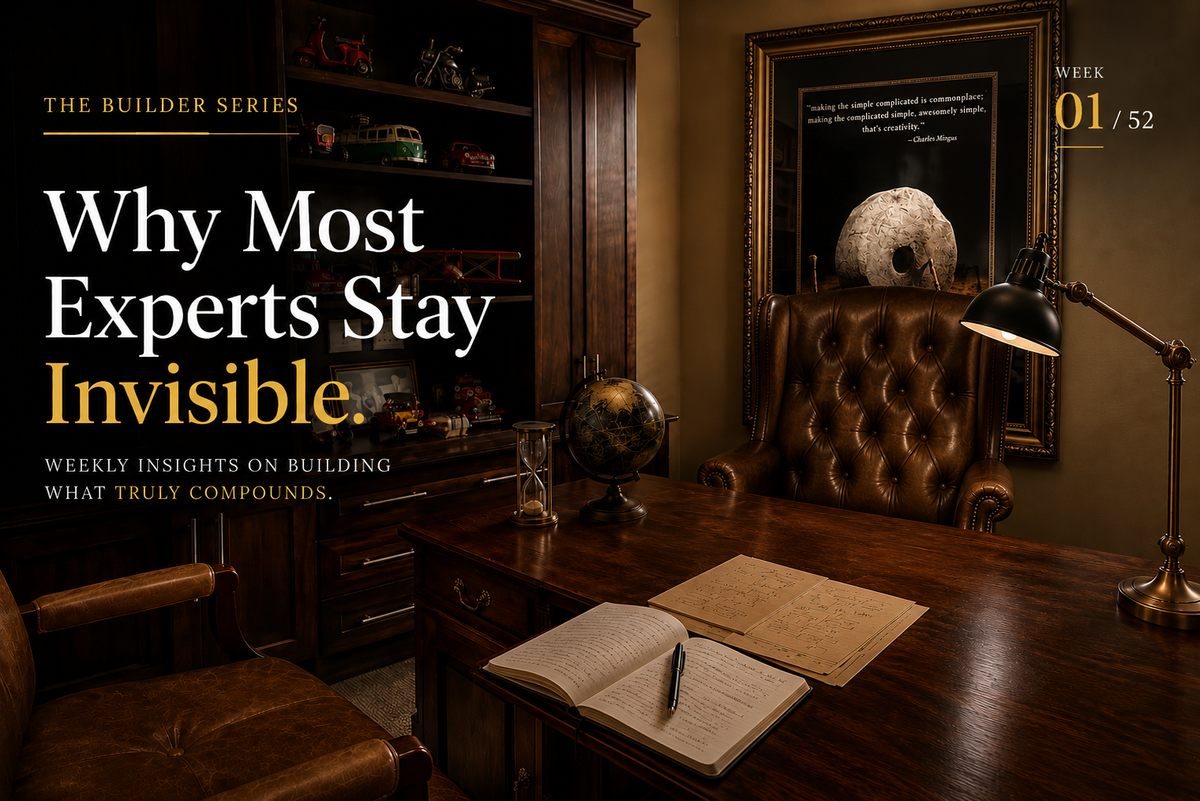
The Builder Series 01/52
Why Most Experts Stay Invisible
Most experts never become authorities.
At first glance, this seems irrational.
We assume expertise naturally attracts opportunity.
We assume good work eventually gets noticed.
We assume competence rises to the surface.
Yet experience suggests otherwise.
The world is full of highly capable people who remain largely unknown.
Exceptional teachers.
Exceptional operators.
Exceptional builders.
Exceptional business owners.
Exceptional professionals.
Many spend decades developing valuable skills, solving difficult problems, and creating meaningful outcomes.
Yet their influence rarely reflects their capability.
The question is why.
The common explanation is visibility.
People say these experts need better marketing, more followers, more exposure, or a larger audience.
There is some truth in that.
But visibility is not the root issue.
The deeper issue is authority.
Expertise and authority are not the same thing.
Expertise is what you know.
Authority is what other people trust.
One can exist without the other.
A person can possess extraordinary expertise and remain largely unknown.
Another can be highly visible while possessing very little authority.
The distinction matters because influence is rarely granted on the basis of knowledge alone.
Influence is granted when knowledge becomes trusted.
This is where many capable people get stuck.
They assume expertise automatically becomes authority.
In reality, there are several leaks along the path.
Knowledge is acquired.
Experience is accumulated.
Capability is developed.
But somewhere between expertise and impact, the value escapes.
That is the purpose of this first Builder Framework.
The framework identifies five authority leaks.
They appear simple.
Yet they explain why so many capable people struggle to convert expertise into opportunity.
Some learn continuously but never publish what they know.
As a result, their expertise remains invisible.
Others appear inconsistently.
Trust never has the chance to compound.
Some attempt to speak about everything.
The market remembers them for nothing.
Others share information without creating understanding.
People consume the content and move on unchanged.
And many confuse visibility with authority.
People may notice them.
Few trust them.
Each leak appears small in isolation.
Over time, however, they compound.
This is an important observation.
Authority does not disappear through a single mistake.
It disappears through hundreds of small omissions.
The article never published.
The insight never shared.
The promise not kept.
The inconsistency tolerated.
The reputation never deliberately built.
Builders understand something different.
Authority is not an event.
Authority is a compounding process.
It is built through repeated demonstrations of usefulness.
One insight.
One framework.
One promise kept.
One problem solved.
Repeated consistently over time.
The process is slower than most people would like.
Yet it is remarkably durable.
Because authority built on trust tends to endure.
That is why the path in this framework matters:
Expertise → Trust → Authority → Influence → Impact
Most people focus on influence.
Builders focus on trust.
Trust is where compounding begins.
The broader Builder Series is an investigation into a single question:
Why do some people, families, businesses, institutions, and nations compound value across generations while others dissipate it?
This first framework introduces the principle that underpins Module One: Authority.
Authority is not built when people notice you.
Authority is built when people trust you.
And trust compounds long before influence becomes visible.
← Home