The Real Inheritance Is Not Wealth

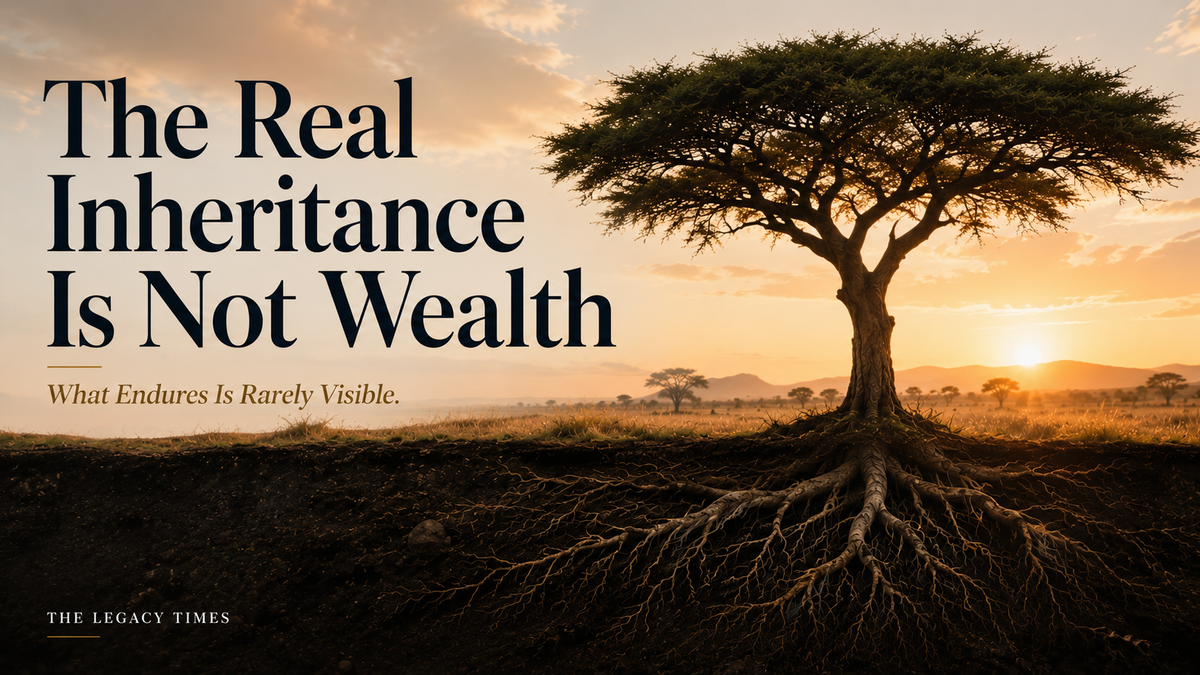
Why the families that endure focus on transferring capability, not merely capital.
Most people misunderstand inheritance.
Ask someone what a family leaves behind and the answers are usually predictable: money, property, businesses, investments, trusts or land. We instinctively think of inheritance as the transfer of assets from one generation to the next. The larger the asset base, the more successful the inheritance appears.
Yet history suggests a more complicated reality.
Across cultures, continents and centuries, remarkably similar observations have emerged about the fragility of family wealth. The Chinese speak of wealth lasting no more than three generations. In Japan, similar proverbs warn of prosperity fading with time. In Europe and North America, the phrase “shirtsleeves to shirtsleeves in three generations” became part of the cultural vocabulary long before modern family offices existed.
Different societies arrived at the same conclusion because they observed the same pattern.
Families build wealth.
Families enjoy wealth.
Families lose wealth.
The repetition of this cycle has become so familiar that many people now treat it as inevitable.
I am not convinced it is.
The more I have studied wealth, family businesses, stewardship and continuity, the more I have come to believe that most families do not lose their wealth because they fail to transfer assets.
They lose it because they fail to transfer the capability that created those assets in the first place.
This distinction is not semantic. It changes how we think about succession, governance, family leadership and legacy itself.
The traditional view assumes wealth is the asset.
I would argue that wealth is often the by-product of a far more important asset.
Capability.
The ability to identify opportunities when others see obstacles.
The ability to allocate resources effectively.
The discipline to delay gratification.
The judgment to make difficult decisions.
The resilience to navigate uncertainty.
The stewardship to preserve what has been built.
These qualities create wealth. Wealth itself does not create these qualities.
That may sound obvious, but the implications are profound.
A successful entrepreneur rarely becomes wealthy because they possessed capital. More often, they become wealthy because they possessed a combination of vision, discipline, perseverance, adaptability and judgment. Capital was the result, not the cause.
Yet when succession planning begins, many families focus overwhelmingly on transferring the result while paying comparatively little attention to transferring the cause.
Assets are documented.
Trusts are established.
Tax structures are implemented.
Ownership is transferred.
Meanwhile, the deeper questions often receive far less attention.
How is judgment transferred?
How is responsibility cultivated?
How is stewardship taught?
How are values preserved?
How is entrepreneurial capability developed in people who never experienced the circumstances that originally produced it?
These questions are harder to answer because they cannot be solved through legal structures alone.
They require intentionality.
The challenge becomes even clearer when we examine the difference between first-generation wealth creators and their descendants.
Founders are often shaped by necessity. Scarcity teaches lessons that abundance rarely can. Limited resources force prioritisation. Constraints develop creativity. Failure teaches resilience. Responsibility develops maturity. The process of building something from nothing forms capabilities that become embedded in the individual.
The difficulty is that experiences cannot be inherited.
A child can inherit ownership in a business.
They cannot inherit the lessons learned while building it.
A grandchild can inherit a portfolio.
They cannot inherit the judgment that originally constructed it.
An heir can inherit wealth.
They cannot inherit stewardship.
Those qualities must be developed.
This is where many discussions around generational wealth become overly simplistic.
It is tempting to attribute wealth destruction to entitlement, poor character or irresponsible heirs. While these factors occasionally play a role, they often represent symptoms rather than causes.
The deeper issue is that capability was never intentionally transferred.
The family successfully transferred ownership but failed to transfer understanding.
They transferred assets but not responsibility.
They transferred wealth but not stewardship.
In many cases, the eventual loss of wealth simply reveals a much earlier failure of preparation.
The irony is that the families most likely to preserve wealth across generations are often the families least obsessed with wealth itself.
Instead, they focus on the qualities that produce it.
They focus on character.
They focus on stewardship.
They focus on education.
They focus on governance.
They focus on responsibility.
They focus on continuity.
In other words, they focus on capability.
This distinction feels particularly important in Africa today.
Across the continent, a significant generation of entrepreneurs, business owners, investors and professionals is creating wealth at a scale not previously possible. New family businesses are emerging. Family offices are becoming more common. Agricultural enterprises are expanding. Property portfolios are growing. Private capital is maturing.
This is a remarkable development.
Yet wealth creation is only the first chapter of the story.
The more important question is what happens next.
Will these families transfer assets?
Almost certainly.
Will they transfer capability?
That remains to be seen.
The answer to that question may ultimately determine whether Africa’s emerging wealth becomes a temporary phenomenon or a multi-generational force.
Because wealth, on its own, is fragile.
Markets change.
Industries evolve.
Governments rise and fall.
Currencies strengthen and weaken.
Entire sectors can disappear within a generation.
Families that rely exclusively on assets eventually become vulnerable to forces beyond their control.
Families that preserve capability possess something more durable.
They possess the ability to adapt.
They possess the ability to rebuild.
They possess the ability to create value again.
That is why the real inheritance is not wealth.
The real inheritance is the capacity to create, preserve and steward wealth long after the original creators are gone.
Everything else is merely the visible evidence of that deeper asset.
🔙 Home