The Real Inheritance Is Not Wealth

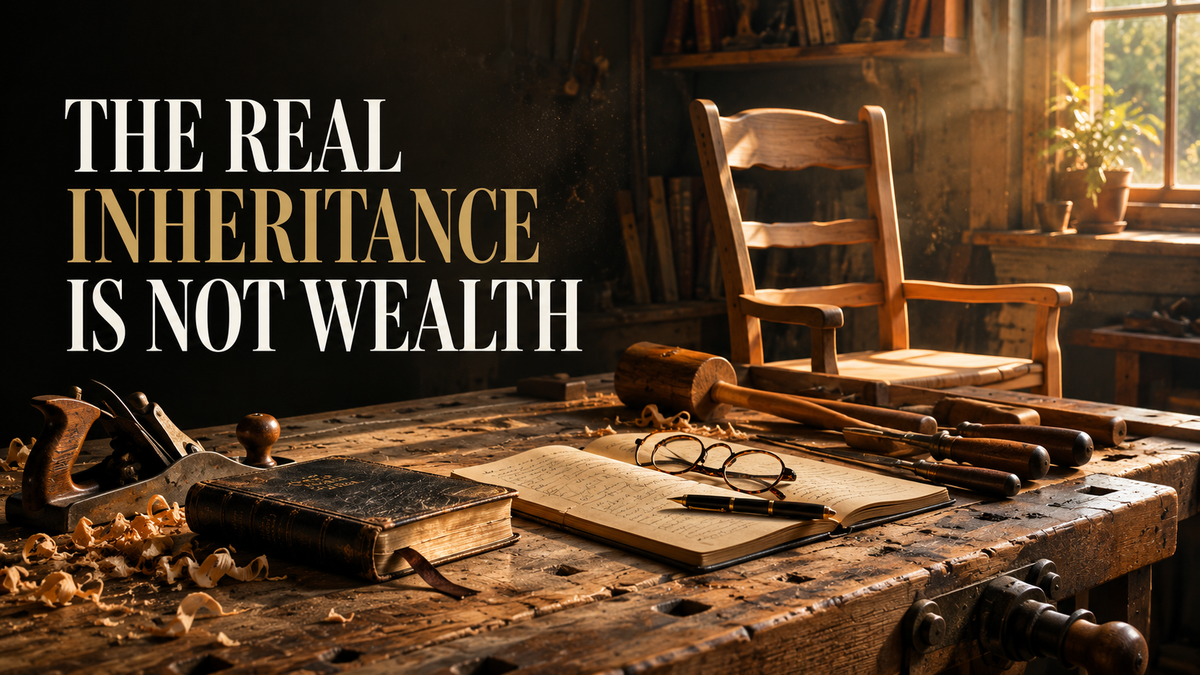
The chair sat empty.
For more than four decades it had been occupied by the same man.
From that chair he built a business.
He signed agreements there. He made difficult decisions there. He weathered recessions, solved crises, took risks, created opportunities, and built something that would ultimately support not only his family, but many others as well.
The chair itself was ordinary.
The man who occupied it was not.
Now he was gone.
The family inherited the shares.
The board inherited the responsibility.
The next generation inherited the opportunity.
But there was one thing nobody inherited.
His judgment.
No legal document could transfer it.
No trust structure could preserve it.
No estate plan could guarantee it.
The very thing that had created the wealth was the one thing that could not be distributed.
And that is where the story of most inheritances truly begins.
Most people think inheritance is about money.
It is not.
Money is merely the visible part.
The real inheritance is almost always invisible.
The Illusion of Wealth Transfer
Modern society places enormous emphasis on financial capital.
Families spend years planning estates.
Businesses spend millions on succession structures.
Advisers develop sophisticated strategies to protect and transfer assets.
All of these things matter.
They should be done well.
But there is a danger in assuming that wealth itself is the inheritance.
History suggests otherwise.
Across generations, fortunes have been built and lost. Businesses have risen and fallen. Families have accumulated extraordinary resources only to see them dissipate within a relatively short period of time.
The reasons vary.
Market conditions change.
Economic environments shift.
Poor decisions are made.
Yet beneath these explanations lies a deeper truth.
The greatest threat to wealth is not taxation, inflation, market volatility, or economic cycles.
The greatest threat to wealth is the assumption that financial capital can survive without moral capital.
Wealth is rarely destroyed by a lack of opportunity.
It is more often destroyed by a lack of stewardship.
A family can transfer ownership.
It cannot transfer wisdom through a signature.
A founder can transfer shares.
He cannot transfer discipline through an estate plan.
Assets can be distributed in a moment.
Character is developed over a lifetime.
What Truly Gets Passed On
Every generation inherits far more than it realizes.
Long before children inherit property, they inherit examples.
They inherit attitudes toward work.
They inherit beliefs about responsibility.
They inherit habits around money.
They inherit views about service, faith, leadership, and sacrifice.
Some of these lessons are taught intentionally.
Many are absorbed simply by observation.
Children watch how parents respond to adversity.
Employees observe how leaders handle power.
Communities learn from the standards their institutions choose to uphold.
Whether we realize it or not, we are constantly transmitting values.
The question is not whether we will leave an inheritance.
The question is what kind.
Will the next generation inherit entitlement or stewardship?
Consumption or responsibility?
Comfort or purpose?
Dependence or capability?
These questions ultimately determine whether wealth becomes a blessing or a burden.
The Stewardship Principle
Ownership is temporary.
Stewardship is enduring.
Everything we manage today was entrusted to us by someone who came before us.
The businesses we lead.
The institutions we serve.
The opportunities we enjoy.
The freedoms we often take for granted.
Very little begins with us.
And very little ends with us.
A steward understands that his responsibility extends beyond personal benefit.
He recognizes that what has been entrusted to him must be preserved, strengthened, and passed on in better condition than it was received.
This principle applies equally to capital and culture.
To families and institutions.
To communities and nations.
The best leaders do not ask, “What can I build?”
They ask, “What can I leave behind that will continue to create value after I am gone?”
That is a fundamentally different question.
One produces success.
The other produces legacy.
The Empty Chair
Eventually every chair becomes empty.
Every founder leaves the business.
Every parent leaves the family table.
Every leader leaves the institution.
Every steward leaves the responsibility in someone else’s hands.
This is not tragedy.
It is reality.
The measure of a life is not whether this moment arrives.
The measure is whether others are prepared when it does.
Many leaders spend decades making themselves indispensable.
Everything depends on them.
Every decision flows through them.
Every relationship belongs to them.
Every piece of knowledge remains locked within them.
The result is predictable.
The organization appears strong while they are present.
Its weaknesses become visible once they leave.
This is not legacy.
It is dependency.
True leadership prepares others to carry responsibility.
True stewardship creates continuity.
True legacy survives the departure of its creator.
The strongest institutions in history were never built around personalities.
They were built around principles.
Why Institutions Matter
This lesson extends far beyond families and businesses.
It applies equally to nations.
Strong societies are not built merely by extraordinary individuals.
They are built by institutions capable of preserving values across generations.
When institutions become dependent on personalities, they become fragile.
When they are rooted in principles, they become resilient.
A nation prospers when its institutions remain stronger than any individual.
A family prospers when its values remain stronger than its circumstances.
A business prospers when its purpose survives beyond its founder.
The future belongs not to those who accumulate the most power, but to those who prepare the most successors.
That principle is as true in leadership as it is in family life.
A Biblical View of Inheritance
Scripture consistently presents inheritance as something far greater than material wealth.
Proverbs 13:22 declares:
“A good man leaves an inheritance to his children’s children.”
The verse certainly includes financial provision.
But it cannot be limited to it.
A meaningful inheritance includes wisdom.
It includes faith.
It includes character.
It includes responsibility.
It includes the capacity to govern resources well.
Throughout Scripture, we see leaders whose greatest contributions were not what they completed personally, but what they prepared for others.
Moses never entered the Promised Land.
Yet he prepared Joshua.
David never built the Temple.
Yet he gathered resources, established plans, and prepared the way for Solomon.
Neither man saw the full fruit of his labour.
Yet both left legacies that extended far beyond their own lifetimes.
They understood a truth that modern culture often forgets.
Faithfulness is not measured solely by what we accomplish.
It is also measured by what we make possible for those who come after us.
The Legacy Question
Every person reading this will one day leave something behind.
The question is not whether we will leave an inheritance.
We will.
The question is what kind.
Will we leave only assets?
Or will we leave wisdom?
Will we leave possessions?
Or will we leave principles?
Will we leave wealth?
Or will we leave stewardship?
One day the chair we occupy will be empty.
Someone else will sit where we once sat.
Someone else will make the decisions.
Someone else will carry the responsibility.
What remains at that moment will reveal the true nature of our inheritance.
Not the assets transferred.
Not the titles held.
Not the achievements recorded.
What remains are the values that were taught, the responsibilities that were modelled, the people who were prepared, and the institutions that were strengthened.
A bank account can be transferred in a day.
A legacy is transferred over a lifetime.
That is the real inheritance.
Not wealth alone.
But stewardship.
Not success alone.
But responsibility.
Not assets alone.
But wisdom.
Because what truly gets passed on cannot be held in your hands.
Faith • Structure • Impact