Stewardship Determines Continuity
Continuity depends less on beginnings than on stewardship. Families, institutions and nations weaken when maintenance, discipline and long-term responsibility are neglected across generations.

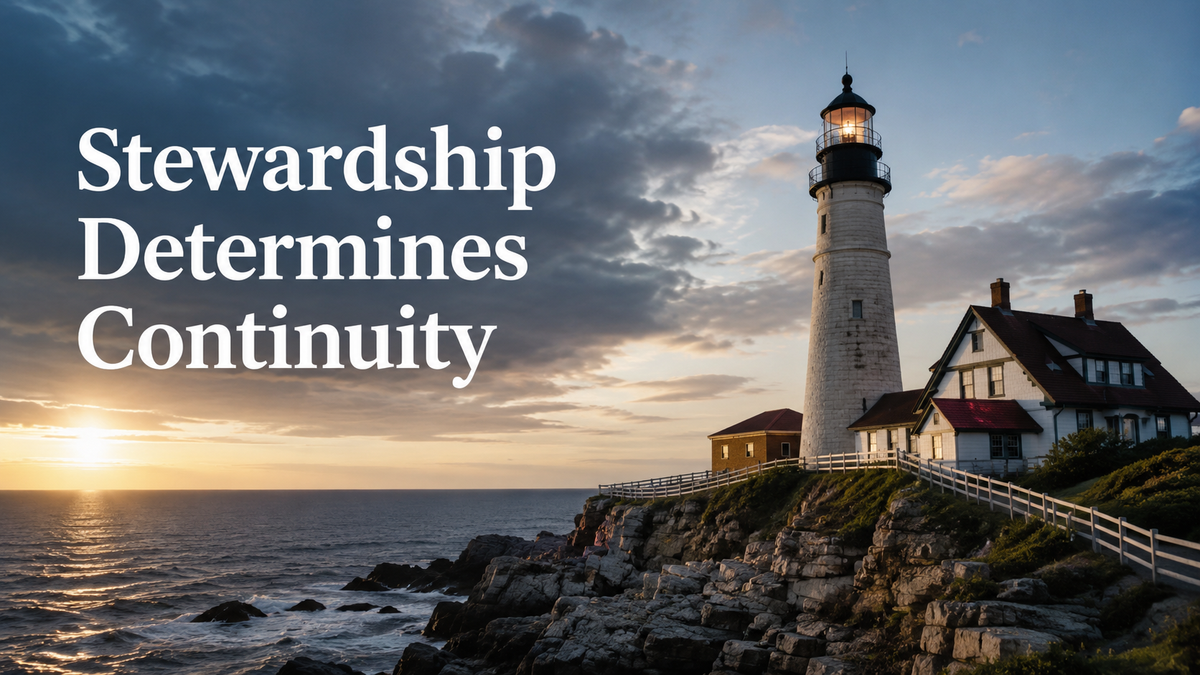
Every lasting institution is eventually tested by stewardship.
Not by vision alone.
Not by ambition alone.
Not even by resources alone.
But by whether responsibility can be sustained across time.
Many people are capable of building.
Far fewer are capable of preserving, strengthening and transferring what has been built responsibly to the next generation.
This is one of the great challenges facing families, businesses, nations and civilizations alike.
Creation often receives more attention than stewardship because building is visible. It attracts recognition, momentum and public admiration. Stewardship is quieter. It happens through maintenance, discipline, governance and long-term responsibility repeated consistently over years.
Yet continuity depends far more on stewardship than on beginnings.
Without stewardship:
- institutions weaken
- wealth deteriorates
- infrastructure declines
- standards erode
- cultures fragment
- systems become unstable
This pattern appears repeatedly throughout history.
Many societies inherited strong institutions, productive economies and stable infrastructure built through the sacrifices of previous generations. But without disciplined stewardship, these systems gradually weakened through neglect, short-term thinking and declining responsibility.
Stewardship requires thinking beyond immediate gain.
It asks whether decisions made today strengthen or weaken the ability of future generations to flourish. This applies to:
- leadership
- capital
- infrastructure
- education
- governance
- agriculture
- institutions
- family systems
Strong stewardship understands that inheritance is not ownership in the absolute sense. It is responsibility carried temporarily across time.
This is why maintenance matters so deeply.
Roads do not preserve themselves.
Institutions do not sustain themselves.
Trust does not maintain itself.
Civilization itself requires continuous stewardship.
Once maintenance weakens consistently, deterioration accelerates quietly beneath the surface until systems become increasingly fragile and expensive to restore.
The same principle applies financially.
Wealth that survives generations usually depends less on aggressive accumulation and more on disciplined stewardship:
- governance
- prudent allocation
- long-term thinking
- productive investment
- responsible succession
- preservation of institutional trust
Without stewardship, wealth often disappears within relatively short periods despite strong beginnings.
Leadership also changes under stewardship.
Responsible leaders recognize that their role is not merely to maximize short-term visibility, but to strengthen systems capable of sustaining continuity after they are gone. This requires humility because stewardship places greater emphasis on preservation and transfer than on personal recognition.
Nations are shaped by this principle as well.
Countries that invest consistently in:
- infrastructure
- education
- institutional integrity
- productive capacity
- energy systems
- agricultural resilience
are often strengthening continuity even when results are not immediately visible publicly.
Stewardship compounds quietly.
So does neglect.
This is why continuity should never be assumed automatically. Every generation inherits systems it did not fully build and carries responsibility for whether those systems strengthen or weaken before being passed forward again.
The future is rarely determined only by what societies create.
It is determined by what they are capable of sustaining responsibly across time.
Because ultimately, continuity is not secured through ambition alone.
It is secured through stewardship disciplined enough to preserve, strengthen and transfer value across generations.
Know a founder, investor, or builder who needs to read this?
Forward it. One share builds one legacy.