Africa’s Diaspora Sends Tens Of Billions Home Every Year.
Africa’s diaspora already represents one of the continent’s largest economic forces. The next opportunity lies in transforming global African capital, expertise and networks into productive systems capable of strengthening long-term development across generations.

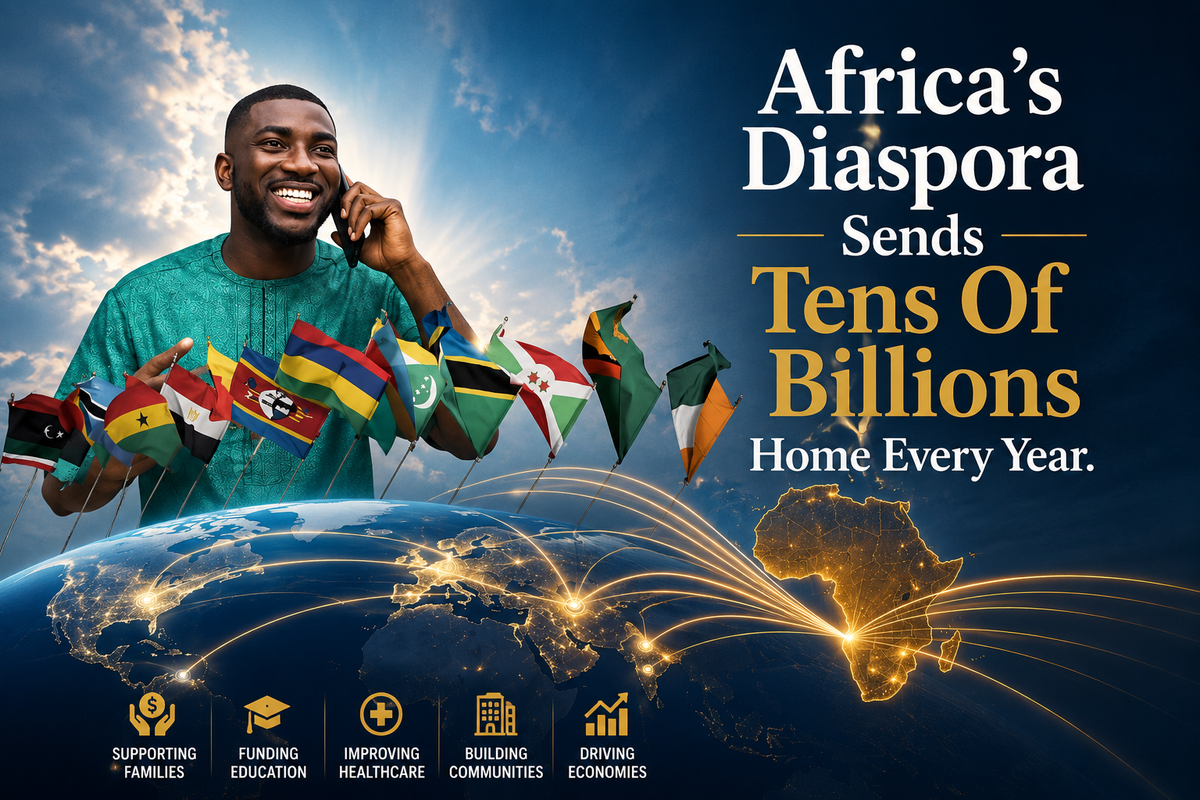
Africa’s diaspora sends tens of billions back home annually, while broader diaspora-linked capital flows may already exceed $100 billion across formal and informal channels.
That is not a small statistic.
It represents one of the largest globally distributed economic networks connected directly to the African continent.
But there is an important distinction many people miss:
Remittances alone do not build long-term productive economies.
They provide:
- relief
- support
- consumption stability
- education funding
- healthcare access
- household resilience
All of which matter enormously.
But long-term economic transformation usually happens when capital increasingly moves toward:
- infrastructure
- ownership
- productive enterprises
- industrialization
- energy systems
- logistics
- manufacturing
- technology
- long-term investment structures
The real opportunity is not simply sending money home.
The real opportunity is coordinating:
- African capital
- African expertise
- African networks
- African entrepreneurship
- African institutional knowledge
into productive systems capable of compounding across generations.
Africa’s diaspora already possesses:
- global operational experience
- engineering expertise
- financial knowledge
- healthcare leadership
- technology capability
- entrepreneurial experience
- international market access
- institutional exposure
The challenge is not potential.
The challenge is structure.
Many diaspora investors and founders want to contribute more meaningfully to Africa’s future.
But several constraints continue limiting productive deployment:
- weak governance structures
- fragmented opportunities
- lack of trusted operators
- insufficient transparency
- infrastructure bottlenecks
- political uncertainty
- poor capital coordination
- weak long-term planning systems
Capital moves where trust exists.
And trust usually depends on:
- governance
- structure
- accountability
- continuity
- operational competence
This is why family offices, investment structures and long-term governance systems may become increasingly important across Africa over the next decade.
Strong structures help create:
- continuity
- stewardship
- capital coordination
- succession planning
- productive long-term investment
- institutional resilience
Africa does not only need more capital.
It needs stronger systems capable of aligning the capital, talent and networks it already possesses.
The future will likely belong to societies capable of coordinating:
- people
- capital
- infrastructure
- production
- governance
- long-term incentives
more effectively than others.
Africa’s diaspora may already represent one of the continent’s greatest untapped strategic advantages.
The question is whether the systems required to compound that advantage will be built in time.
At The Legacy Times, much of our work focuses on generational wealth, governance, productive systems and the long-term structures required to strengthen continuity across Africa.
For founders, family offices, diaspora investors and long-term builders seeking guidance around wealth structuring, stewardship and continuity:
Know a founder, investor, or builder who needs to read this?
Forward it. One share builds one legacy.