Productive Capacity Determines Sovereignty
Nations become vulnerable when critical systems required for long-term stability sit largely outside their own productive control. Sovereignty ultimately depends on the strength of a society’s productive capacity.

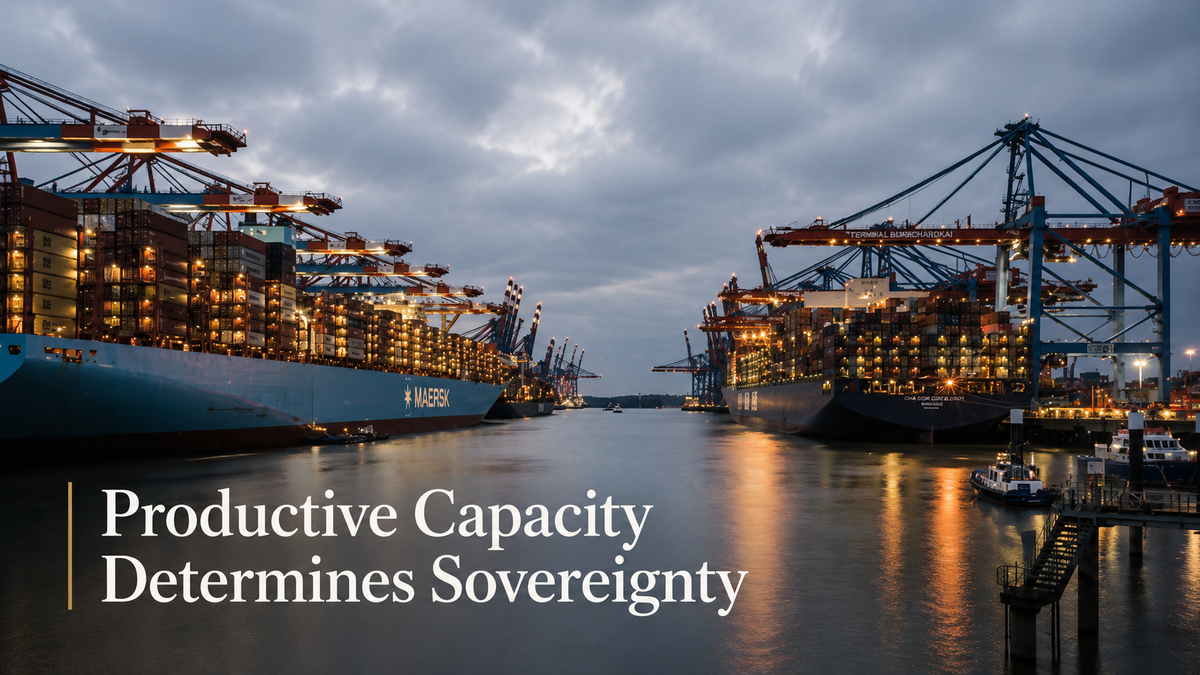
Every society depends on production.
Not only financial activity.
Not only consumption.
Not only access to capital markets.
Production.
A nation’s long-term resilience is ultimately shaped by its ability to produce the systems, infrastructure, energy, food and industrial capacity required to sustain itself through changing economic conditions and external pressure.
When productive capacity weakens, dependency increases.
This principle has become increasingly important in a world defined by supply chain volatility, geopolitical tension, resource competition and economic fragmentation. Many countries discovered during recent global disruptions that access to critical goods cannot always be assumed during periods of instability.
Production matters because sovereignty depends on continuity under pressure.
Nations capable of producing:
- food
- energy
- industrial goods
- strategic infrastructure
- transportation systems
- technological capability
usually possess greater resilience than societies dependent primarily on external systems for long-term stability.
This is not an argument against trade.
Trade remains essential to modern economies.
But healthy trade relationships differ from structural dependency. Countries become vulnerable when critical systems required for national continuity sit largely outside their own productive control.
This is why industrial depth matters.
Strong economies are rarely built solely on finance, speculation or consumption. Sustainable resilience usually depends on productive sectors capable of generating real economic output:
- manufacturing
- agriculture
- logistics
- energy
- infrastructure
- engineering
- industrial processing
These sectors create stability because they strengthen the foundations underneath economic activity itself.
Africa possesses enormous productive potential.
The continent contains:
- strategic minerals
- agricultural capacity
- energy resources
- industrial opportunities
- growing human capital
Yet much of this potential still leaves the continent in raw or underprocessed form while higher-value industrial layers remain concentrated elsewhere.
This limits long-term compounding.
Resource wealth without productive infrastructure often creates vulnerability rather than sovereignty. Nations exporting raw materials while importing finished systems remain exposed to external pricing power, supply disruptions and industrial dependency.
This is why infrastructure investment matters so deeply.
Roads, rail systems, ports, power generation and industrial processing facilities are not merely construction projects. They are productive architecture. They determine whether value compounds locally or exits prematurely before strengthening broader economic resilience.
The same principle applies beyond nations.
Businesses weaken when they lose productive discipline and rely entirely on external momentum. Families become fragile when consumption consistently outpaces productive stewardship. Individuals become vulnerable when they possess income without productive assets or durable skills.
Production creates stability because it strengthens continuity.
Societies that neglect productive capacity often become increasingly dependent on systems they do not fully control. Over time, this weakens strategic flexibility and exposes economies to external pressure during periods of instability.
The strongest civilizations throughout history usually maintained some combination of:
- agricultural resilience
- industrial capability
- infrastructure depth
- energy security
- productive labor
- institutional continuity
These systems formed the foundation underneath broader prosperity.
This is why sovereignty cannot be separated from production.
Nations do not remain strong indefinitely through consumption alone. Long-term resilience depends on whether societies continue building, maintaining and strengthening the productive systems required to sustain future generations.
Because ultimately, productive capacity is not merely an economic issue.
It is a civilisational one.
Know a founder, investor, or builder who needs to read this?
Forward it. One share builds one legacy.