Ownership Matters More Than Participation
Participation creates activity, but ownership creates leverage. Nations and institutions that fail to control productive systems often remain dependent, even while participating actively in global markets.

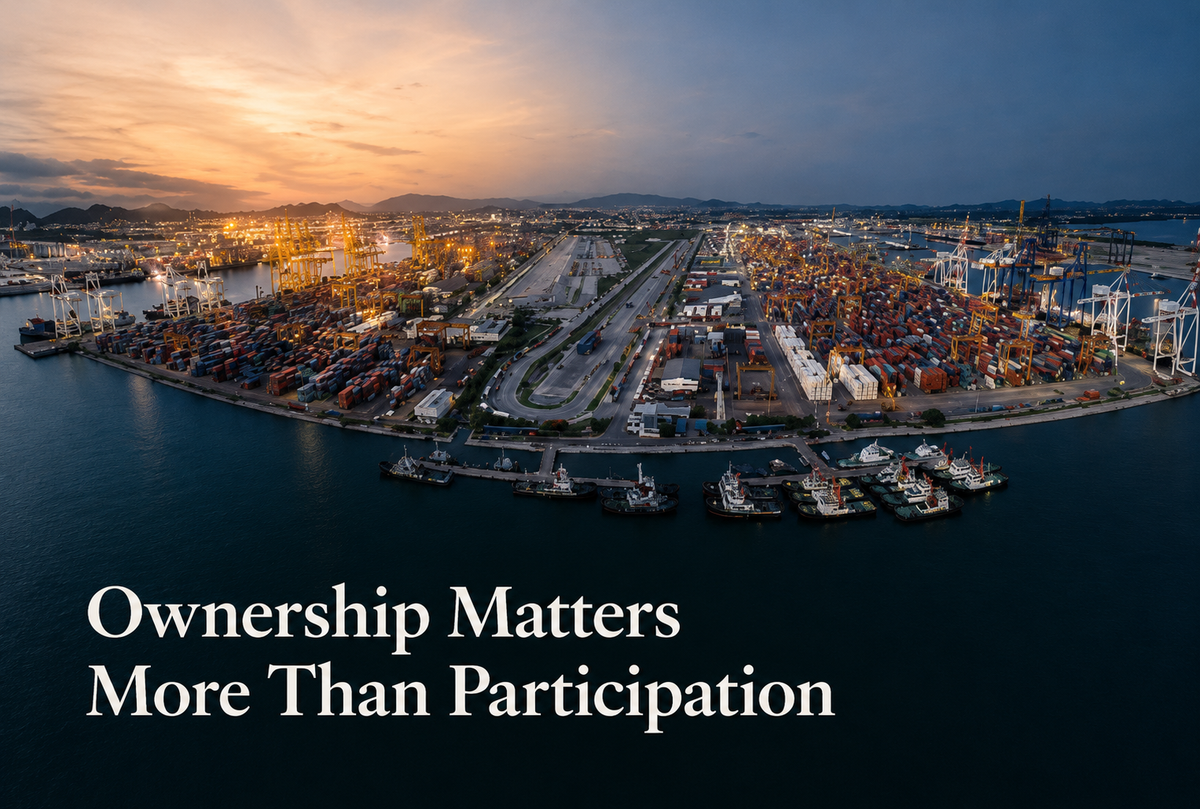
Many nations participate in the global economy.
Far fewer control meaningful portions of the systems that generate long-term value inside it.
This distinction matters more than most people realize.
Participation creates activity.
Ownership creates leverage.
A country can export large volumes of commodities, attract investment and remain active in international trade while still capturing only a small portion of the value created from its own resources and labor. Economic participation alone does not automatically translate into resilience, sovereignty or long-term prosperity.
The same principle applies beyond nations.
Businesses can generate revenue without owning strategic infrastructure.
Workers can participate in industries without accumulating productive assets.
Communities can contribute labor while remaining excluded from capital ownership.
Over time, the difference between participation and ownership compounds dramatically.
Ownership influences:
- pricing power
- decision-making
- capital allocation
- production control
- long-term wealth creation
- institutional stability
Participation alone rarely provides the same level of continuity.
This is one of the defining economic questions facing Africa over the coming decades.
The continent possesses extraordinary productive potential, yet in many sectors the highest-value layers of the economic chain still sit elsewhere:
- processing
- manufacturing
- logistics
- financing
- intellectual property
- technology
- distribution
As a result, many economies remain heavily dependent on external systems despite participating actively in global trade.
Dependency often develops quietly.
It begins when nations export raw value while importing higher-value systems. Over time, this weakens local industrial depth, limits productive ownership and concentrates leverage externally.
This is why productive infrastructure matters so deeply.
Ownership is strengthened when countries build:
- energy systems
- transport networks
- industrial capacity
- financial institutions
- agricultural resilience
- educational quality
- productive industries
These systems allow value to remain and compound locally rather than leaving prematurely.
The same principle applies personally.
Many people pursue income while neglecting ownership entirely. Yet income without productive assets often creates vulnerability over time. Ownership creates stability because it produces continuity beyond immediate labor.
This does not only apply to money.
Ownership also exists in:
- ideas
- institutions
- land
- productive systems
- intellectual property
- businesses
- infrastructure
The strongest societies understand this.
They think long term about preserving strategic control over the systems most critical to national resilience and future growth.
Ownership also requires stewardship.
Assets without discipline eventually deteriorate. Productive systems without governance weaken over time. Wealth without responsibility becomes fragile.
This is why sustainable ownership is never merely about accumulation.
It is about continuity.
The nations and institutions that thrive over the coming decades will likely be those capable of moving beyond participation toward productive ownership across critical sectors of their economies.
Because while participation may create temporary movement, ownership determines who ultimately shapes the future direction of value itself.
And without ownership, even large-scale participation can still leave societies dependent on systems they do not control.
If this resonated — you belong here.
Subscribe to The Legacy Times at legacytimes.news
Know a founder, investor, or builder who needs to read this?
Forward it. One share builds one legacy.