Nations Decline Long Before They Collapse
Most national decline begins quietly beneath the surface. Long before collapse becomes visible, institutions, infrastructure, standards and productive systems are often already weakening through years of accumulated neglect.

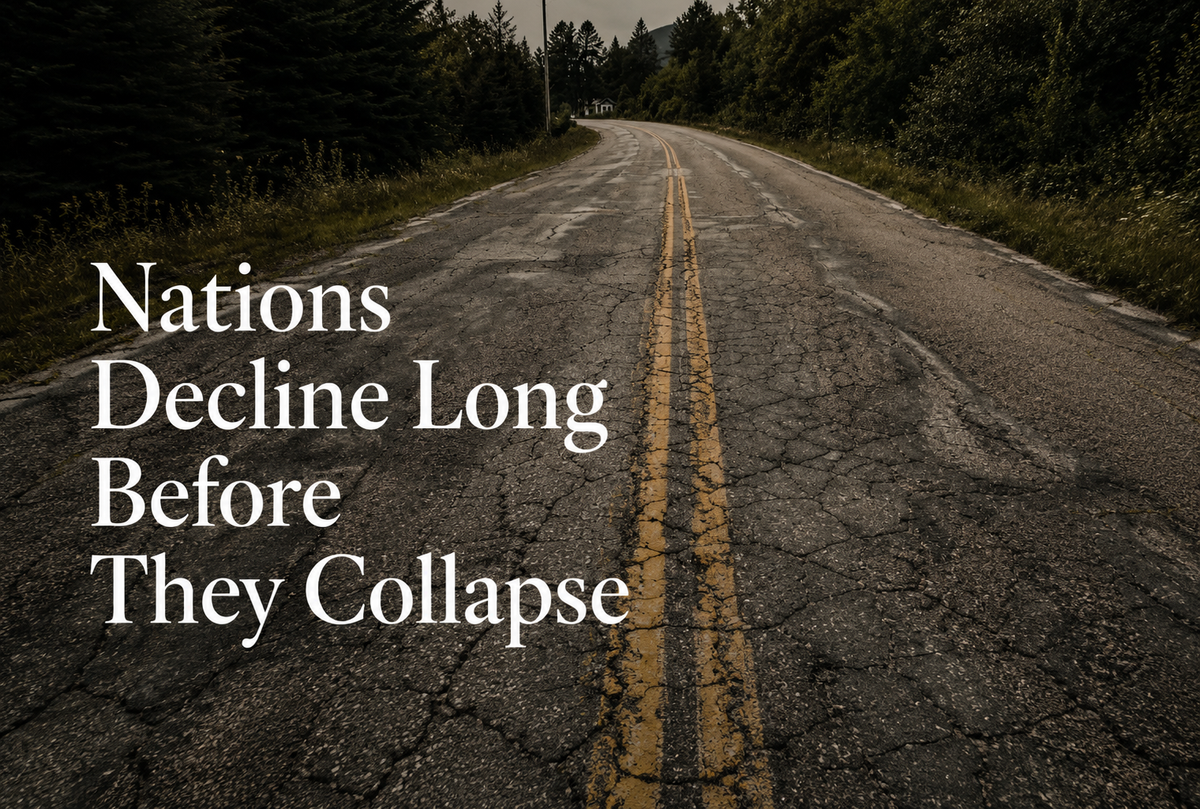
Most national decline happens quietly.
Long before currencies weaken, institutions fail or infrastructure deteriorates visibly, deeper forms of erosion are usually already underway beneath the surface.
Decline often begins in culture before it appears in economics.
It starts when:
- short-term thinking replaces stewardship
- consumption outpaces production
- institutions weaken
- standards deteriorate
- discipline declines
- corruption normalizes
- infrastructure maintenance is neglected
- leadership loses long-term orientation
These shifts rarely appear dramatic at first.
In many cases, nations continue functioning for years while foundational systems steadily weaken underneath them.
This is one reason decline can be difficult to recognize in real time.
People often assume stability because visible structures still exist:
- roads still operate
- markets still function
- buildings still stand
- governments still govern
But institutions can remain operational long after their underlying strength begins eroding.
The most resilient societies understand that continuity depends not only on economic activity, but on preserving the systems and values sustaining productive civilization over generations.
This includes:
- institutional trust
- educational quality
- energy reliability
- productive infrastructure
- rule of law
- family stability
- responsible governance
- cultural discipline
- long-term investment
When these weaken consistently, societies become increasingly vulnerable even if temporary prosperity remains visible.
History demonstrates this repeatedly.
Many civilizations did not collapse suddenly.
They weakened gradually through accumulated neglect, fragmentation, internal instability and the erosion of institutional integrity.
Eventually, visible decline simply revealed damage that had already existed for years beneath the surface.
This principle also applies economically.
Nations that consume more than they produce for extended periods often increase dependency over time. Economies that neglect productive capacity become increasingly fragile during external shocks.
Strong societies usually maintain some combination of:
- production
- infrastructure
- energy security
- agricultural resilience
- industrial depth
- institutional continuity
Without these foundations, prosperity becomes difficult to sustain.
Leadership plays a decisive role in this process.
Responsible leadership requires thinking beyond election cycles, quarterly reporting periods and immediate political incentives. Long-term stewardship means strengthening systems capable of sustaining future generations, not merely preserving short-term appearances.
This is one reason infrastructure matters so deeply.
Infrastructure reflects whether societies are investing in continuity or merely consuming the inheritance created by previous generations.
Maintenance itself is a form of civilization.
Roads, rail systems, energy networks, schools, ports and institutions all require continuous stewardship. Once maintenance declines consistently, deterioration accelerates quietly until systems become increasingly expensive and difficult to restore.
The same principle applies culturally.
Nations weaken when cynicism replaces responsibility, when standards collapse and when productive contribution is no longer valued. Social trust erodes gradually before fragmentation becomes visible publicly.
This does not mean decline is inevitable.
Societies can recover when leadership, institutions and citizens commit themselves to rebuilding productive capacity, restoring standards and strengthening long-term systems again.
But renewal requires honesty.
Nations rarely recover by denying structural weakness.
They recover by confronting it early enough to rebuild before decline becomes irreversible.
Because by the time collapse becomes obvious, deterioration has often already been unfolding for decades beneath the surface.
If this resonated — you belong here.
Subscribe to The Legacy Times at legacytimes.news
Know a founder, investor, or builder who needs to read this?
Forward it. One share builds one legacy.