Infrastructure Is Economic Power
Infrastructure shapes the speed, efficiency and resilience of nearly every productive system within a society. Strong infrastructure reduces friction, while weak infrastructure quietly weakens long-term economic capacity.

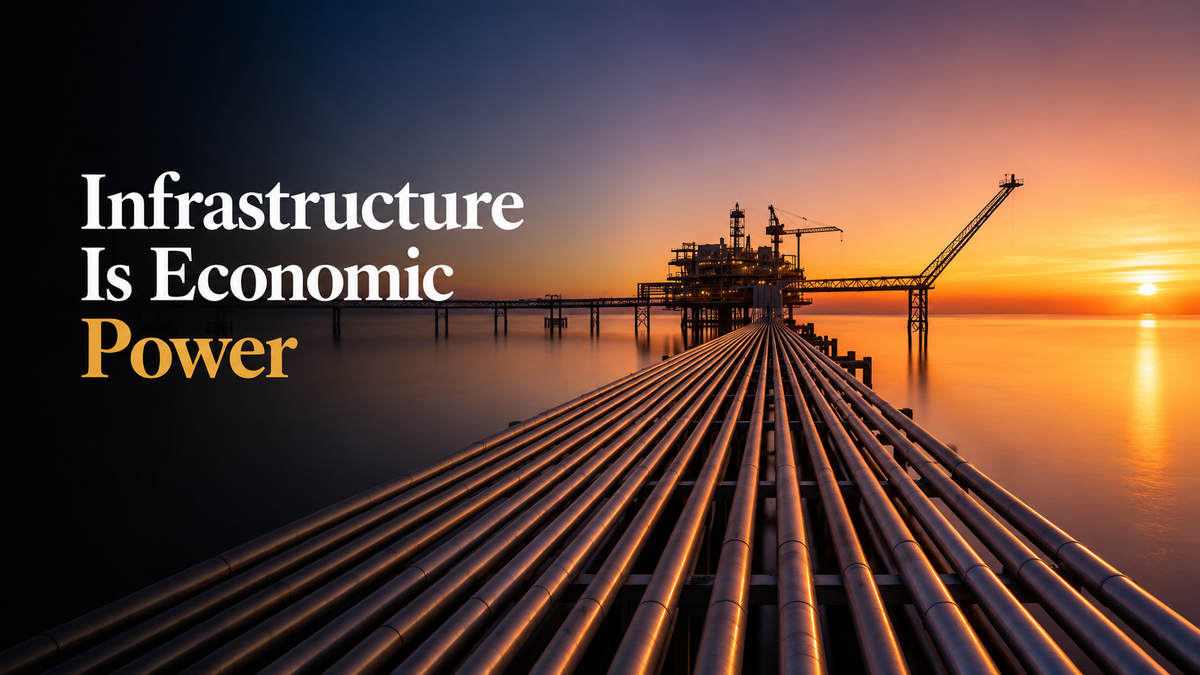
Infrastructure is often discussed as if it exists separately from economic development.
In reality, infrastructure is economic development.
Roads, ports, rail systems, energy networks, water systems and telecommunications infrastructure do far more than support economies. They shape the speed, cost, efficiency and resilience of nearly every productive activity within a society.
Strong infrastructure reduces friction.
Weak infrastructure multiplies it.
This distinction affects everything:
- trade
- manufacturing
- agriculture
- logistics
- investment
- industrial growth
- education
- healthcare
- labor mobility
- energy reliability
Infrastructure determines whether productive systems can operate consistently and competitively across time.
This is why infrastructure should never be viewed merely as construction.
It is strategic architecture.
A functioning port is not simply a transportation asset. It influences export competitiveness, supply chain efficiency, industrial productivity and national trade capacity. Reliable electricity is not merely a utility service. It determines whether factories operate efficiently, whether businesses remain productive and whether economies can sustain industrial depth.
The same principle applies to transportation systems.
Efficient rail infrastructure lowers logistics costs, improves freight movement and strengthens economic coordination across regions. Poor transportation infrastructure increases delays, inefficiency and production costs throughout the economy.
Over time, these differences compound.
Nations with reliable infrastructure often attract:
- investment
- industrial development
- manufacturing capacity
- productive expansion
- technological growth
because businesses depend on predictable systems.
Infrastructure creates confidence.
Without confidence in energy, transportation, water systems and logistics reliability, productive investment becomes more difficult to sustain over the long term.
This is one reason infrastructure matters so deeply for Africa’s future.
The continent possesses extraordinary natural resources, agricultural potential and demographic opportunity. But productive capacity cannot scale efficiently without strong infrastructure underneath it.
Minerals alone do not create industrial strength.
Agricultural potential alone does not create food security.
Population growth alone does not create prosperity.
Systems determine whether opportunity compounds productively.
This is why infrastructure investment should be viewed as foundational rather than secondary. Infrastructure shapes whether economies remain dependent primarily on raw extraction or develop the productive depth required for long-term resilience.
The issue is not only building infrastructure.
It is maintaining it.
Maintenance itself reflects institutional discipline and long-term stewardship. Roads, rail systems, ports and power infrastructure deteriorate quickly when maintenance weakens consistently over time.
Civilization depends heavily on maintenance.
Many societies inherit infrastructure built through the sacrifice and discipline of previous generations. But without continuous stewardship, even strong systems gradually weaken beneath the surface until reliability declines and costs increase dramatically.
Infrastructure also influences sovereignty.
Countries dependent entirely on external systems for critical logistics, energy or industrial capacity often possess reduced strategic flexibility during periods of geopolitical or economic instability.
Strong infrastructure increases resilience because it strengthens continuity under pressure.
This principle extends beyond governments.
Businesses depend on operational infrastructure.
Communities depend on civic infrastructure.
Families depend on financial infrastructure.
Civilizations depend on productive infrastructure.
The societies most capable of sustaining long-term prosperity are usually those that consistently invest in, maintain and strengthen the systems allowing productive life to function efficiently across generations.
Because ultimately, infrastructure is not simply concrete, steel and energy.
It is organized economic power sustained across time.
Know a founder, investor, or builder who needs to read this?
Forward it. One share builds one legacy.