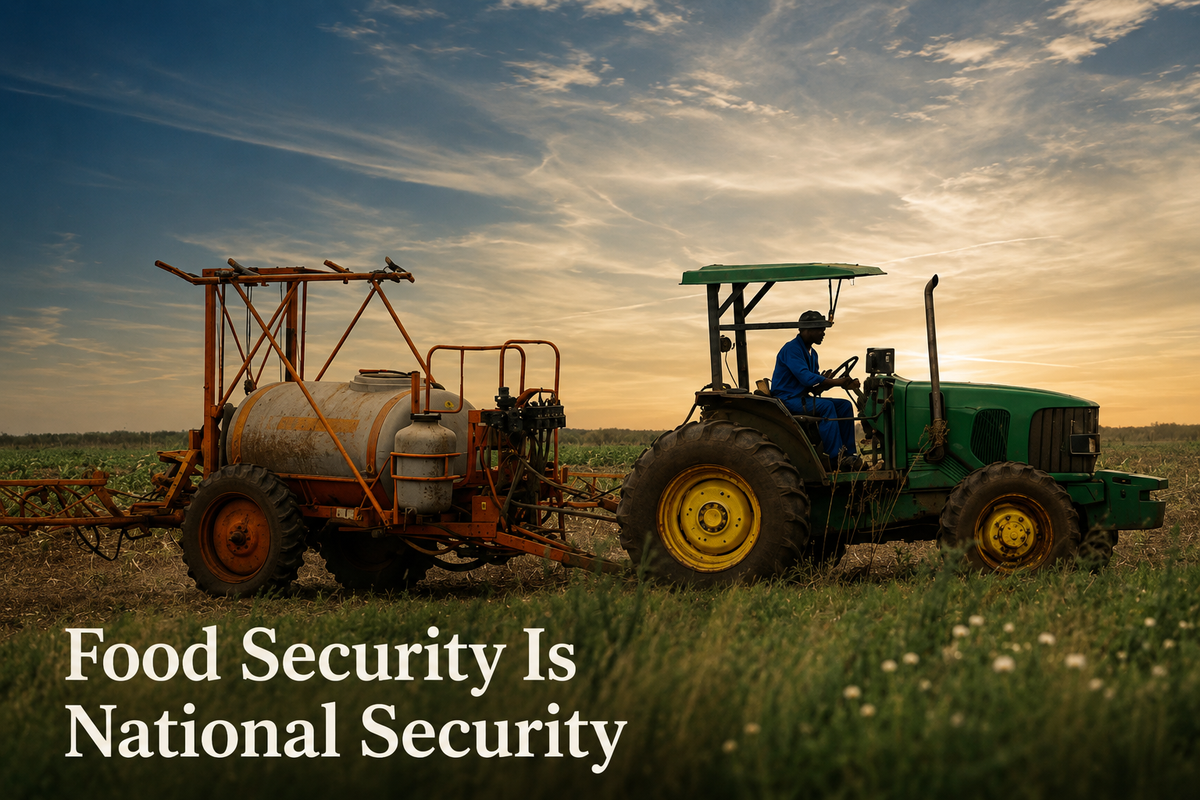
Food Security Is National Security
Food systems determine far more than agriculture alone. They shape national stability, economic resilience and long-term sovereignty. Nations that neglect productive infrastructure eventually expose themselves to dependency and instability.

Every civilisation depends on food.
Not technology first.
Not politics first.
Not financial markets first.
Food.
When food systems weaken, societies become vulnerable regardless of how advanced they appear externally. History repeatedly shows that nations unable to secure stable food production eventually face economic pressure, political instability and social fragmentation.
Food is not merely an agricultural issue.
It is a strategic issue.
It affects:
- national stability
- economic resilience
- public health
- energy systems
- trade dependency
- employment
- inflation
- social cohesion
Yet in many parts of the world, agriculture is still treated as a secondary sector rather than foundational infrastructure.
This is a dangerous mistake.
A nation importing large portions of its food supply becomes increasingly exposed to external shocks:
- currency weakness
- supply chain disruptions
- geopolitical conflict
- droughts
- rising transport costs
- export restrictions
- global market volatility
When food security deteriorates, pressure spreads rapidly through the entire economy.
The effects are rarely isolated.
Food prices influence household stability.
Household stability influences political stability.
Political instability influences investment confidence.
And weakened investment eventually affects long-term national growth.
This is why productive agriculture matters far beyond farming itself.
Agriculture is connected to:
- logistics
- water infrastructure
- transport systems
- energy reliability
- land stewardship
- industrial processing
- trade networks
- employment creation
Strong food systems create resilience.
Weak food systems create dependency.
Africa possesses enormous agricultural potential. The continent contains vast areas of arable land, favorable climates across multiple regions and one of the world’s youngest populations. Yet despite this potential, many African countries still import significant amounts of food while exporting raw agricultural commodities with limited local processing.
This reflects a deeper structural issue.
Too much value leaves the continent before compounding locally.
Production alone is not enough.
Ownership alone is not enough.
The full agricultural value chain matters:
- production
- storage
- transport
- processing
- financing
- distribution
- export capability
- food infrastructure
This is where long-term economic strength is created.
Food systems also require stewardship.
Land cannot be viewed only through the lens of short-term extraction. Productive land must be protected, improved and managed responsibly across generations. Soil health, water systems and agricultural infrastructure determine whether future generations inherit resilience or vulnerability.
The nations that think strategically about food will likely hold major advantages over the coming decades.
Because food security creates:
- stability
- negotiating power
- economic resilience
- social continuity
No country can remain truly strong while depending heavily on external systems for basic survival.
This principle applies beyond governments.
Families and communities also become more resilient when they understand production, stewardship and long-term sustainability rather than consumption alone.
Modern economies often celebrate finance and technology while underestimating the importance of productive capacity. But eventually every society rediscovers the same truth:
People cannot consume what has not first been produced.
And nations that fail to protect productive systems eventually weaken themselves from within.
Food security is therefore not simply about agriculture.
It is about sovereignty.
It is about resilience.
And ultimately, it is about whether a nation possesses the discipline and foresight to protect the foundations that sustain life itself.
Know a founder, investor, or builder who needs to read this?
Forward it. One share builds one legacy.