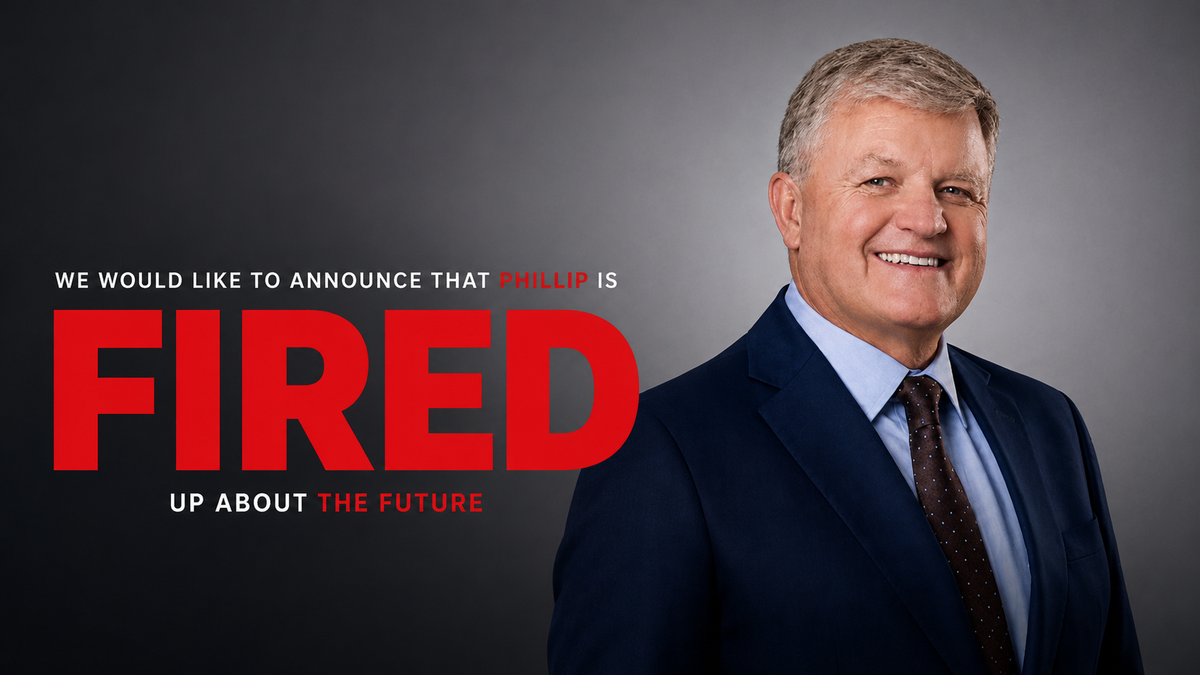
FIRED UP ABOUT THE FUTURE

The dominant emotional posture of modern society appears to be anxiety.
Political instability, economic pressure, technological disruption, debt expansion, geopolitical conflict and institutional distrust have created an environment where many people increasingly approach the future with caution rather than conviction. Entire industries now monetise fear. Media cycles reward outrage. Social platforms amplify pessimism because emotional volatility captures attention more effectively than thoughtful analysis.
Yet despite all of this, I remain deeply optimistic about the future.
Not because I believe the future will automatically improve, and certainly not because I underestimate the seriousness of the challenges facing societies globally, but because periods of structural change have historically created extraordinary opportunity for people, institutions and nations capable of thinking beyond immediate conditions.
This is particularly true for Africa.
Much of the world still tends to analyse Africa primarily through the lens of instability, corruption, inequality or underdevelopment. While many of these challenges are real, they are incomplete observations. Serious investors and long-term builders increasingly understand that demographic momentum, urbanisation, infrastructure expansion, agricultural capacity, digital adoption and natural resource positioning are creating one of the largest long-term economic opportunities of the twenty-first century.
Africa’s population is expected to approach 2.5 billion people by 2050. By the end of the century, nearly forty percent of the global population may live on the continent. That statistic alone carries enormous implications for labour markets, consumer demand, food systems, housing, logistics, energy, financial services and industrial development. Population growth at that scale inevitably creates pressure, but it also creates opportunity for societies capable of building effective systems around it.
Demographics, however, do not create prosperity automatically.
Many nations throughout history have experienced population expansion without achieving durable economic progress because growth without institutional capacity tends to create fragility rather than compounding prosperity. This distinction matters enormously. Economic development is not simply a function of resources or population size. It is largely a function of systems, governance, incentives and long-term thinking.
That is where I believe the real future battle will be fought.
The coming decades will likely reward societies, businesses and families that can combine innovation with continuity, ambition with stewardship and growth with institutional discipline. The future will not belong merely to people capable of generating momentum. It will increasingly belong to people capable of preserving and compounding momentum over long periods of time.
This is one of the great weaknesses visible across many societies today.
Modern culture often glorifies disruption but neglects durability. We celebrate startups more than institutions, rapid growth more than continuity and visibility more than stewardship. As a result, many people learn how to create income but never learn how to preserve capability. They learn how to acquire assets but not how to build structures around those assets. They learn how to generate attention but not how to sustain trust.
This pattern becomes particularly visible when examining family wealth globally.
Research around intergenerational wealth repeatedly shows that a large percentage of family wealth disappears by the third generation. The reason is rarely a lack of intelligence or opportunity. More often, it is the absence of governance, communication, preparation and shared values capable of sustaining continuity across time. Wealth tends to collapse when structure weakens faster than assets compound.
The same principle applies to businesses.
Enduring organisations are rarely built purely through charisma or motivation. They survive because decision-making becomes systematic, culture becomes transferable and governance becomes stronger than individual personalities. The world’s most durable companies are not extraordinary because they avoid mistakes. They are extraordinary because they build mechanisms capable of surviving mistakes.
Increasingly, I believe the future economy will reward exactly these kinds of capabilities.
Artificial intelligence, automation and digital infrastructure will almost certainly continue transforming global labour markets and capital allocation. Entire industries may disappear while entirely new categories of opportunity emerge. During periods like these, reactive thinking becomes dangerous. Long-term thinking becomes strategic infrastructure.
This is one reason I believe Africa still possesses an extraordinary opportunity.
Many developed economies are already attempting to repair institutional fatigue, declining trust, demographic stagnation and deeply entrenched structural complexity. Africa, despite its challenges, still possesses the flexibility and demographic momentum to build differently while growth remains relatively early in its trajectory.
That possibility should not create complacency. It should create responsibility.
Because none of this progress happens automatically.
Economic growth without governance creates instability.
Resource wealth without stewardship creates corruption.
Entrepreneurship without systems creates fragility.
Capital without long-term thinking eventually weakens itself.
This is also why I increasingly believe conversations around faith, stewardship and structure need to mature beyond simplistic narratives.
Faith is not the opposite of preparation. Stewardship is not separate from ambition. Long-term thinking is not pessimism. In many ways, the opposite is true. The willingness to prepare carefully, build patiently and think generationally reflects a deeper understanding of responsibility toward both people and opportunity.
This conviction became one of the reasons I started The Legacy Times.
Not as another publication competing for short-term attention, but as a platform exploring the deeper questions behind continuity, stewardship, wealth creation, systems thinking, family governance, long-term economic development and institutional durability.
Because I believe one of the greatest shortages emerging globally is not information.
It is thoughtful, long-horizon thinking.
The modern world produces enormous quantities of content yet surprisingly little reflection. People are flooded with updates while starving for frameworks. They are surrounded by stimulation but often disconnected from structure. In that environment, the ability to think clearly over long periods of time becomes increasingly valuable.
That is ultimately why I remain optimistic about the future.
Not because I assume progress is guaranteed, but because periods of transition tend to reward disciplined builders disproportionately. They reward people capable of seeing beyond immediate volatility. They reward institutions capable of preserving trust. They reward societies willing to invest in continuity rather than consumption alone.
Most importantly, they reward people willing to build things that survive them.
And despite all the uncertainty surrounding the decades ahead, I believe there are still extraordinary opportunities available for individuals, families, businesses and nations willing to think that way.