Faith Is Not The Opposite Of Preparation

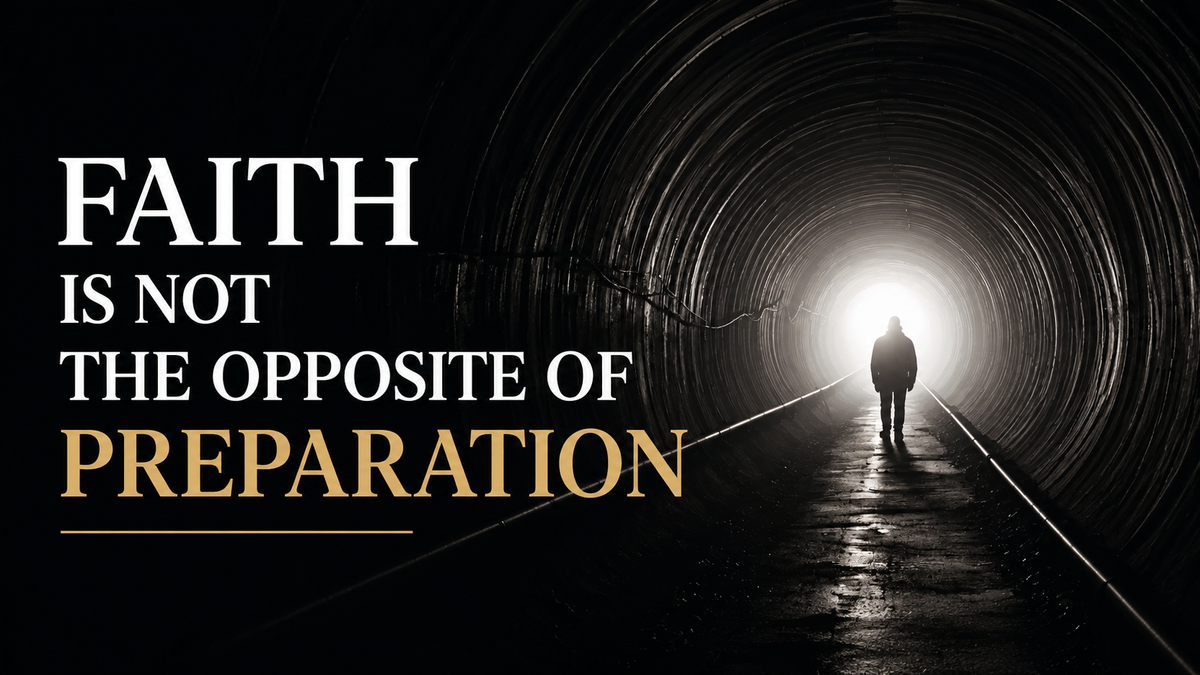
One of the ideas I have returned to repeatedly over the years is how often people speak about faith and preparation as though they exist in tension with one another.
As though trusting God means planning less. As though structure reflects a lack of dependence. As though preparation somehow weakens faith.
Yet the more I study Scripture and observe life, the less convinced I become by that idea.
Throughout the Bible, faith rarely appears passive.
Biblical faith is not inactivity disguised as trust. More often, it appears as faithful stewardship under uncertainty.
People are called before outcomes are visible.
They move before certainty arrives.
They prepare without controlling the result.
Noah built before rain.
Joseph prepared before famine.
Nehemiah prayed and rebuilt.
Again and again, faith seems connected to responsibility.
Not because preparation guarantees outcomes, but because stewardship matters.
That distinction changed something in the way I think.
Preparation is not necessarily evidence of self-reliance.
Sometimes preparation is evidence that we take responsibility seriously.
Sometimes structure is not the absence of faith.
Sometimes structure is the practical expression of faith.
Life has taught me that there are moments where qualifications do not fully explain outcomes. There are opportunities that arrive unexpectedly and doors that open beyond what planning alone could produce.
But I have also noticed something that I continue to find difficult to ignore.
Those moments often seem to meet people who prepared long before they understood why preparation would matter.
Preparation did not create the opportunity.
But it created readiness.
That distinction reaches far beyond business.
It changes how we think about leadership, family, capital and impact.
If we believe something meaningful may be entrusted to us in the future, stewardship asks a difficult question in the present:
Are we becoming capable of carrying what we are praying for?
Because faith does not remove responsibility.
And responsibility does not remove dependence.
One gives direction.
The other creates capacity.
Without faith, structure can become control.
Without structure, faith can become aspiration without execution.
But when the two begin working together, something changes.
Decisions become calmer.
Time horizons become longer.
Stewardship becomes more intentional.
And impact becomes less dependent on urgency and more connected to responsibility.
Perhaps one of the more useful questions we can ask ourselves is not:
Do I have enough faith?
Perhaps the better question is:
Am I preparing faithfully for what I say I believe God can do?
Because throughout Scripture, trust and stewardship seem to walk together.
And perhaps that is where lasting impact begins.
Faith.
Structure.
Impact.
“Commit your work to the Lord, and your plans will be established.”— Proverbs 16:3
— Phillip J. Mostert
♾️