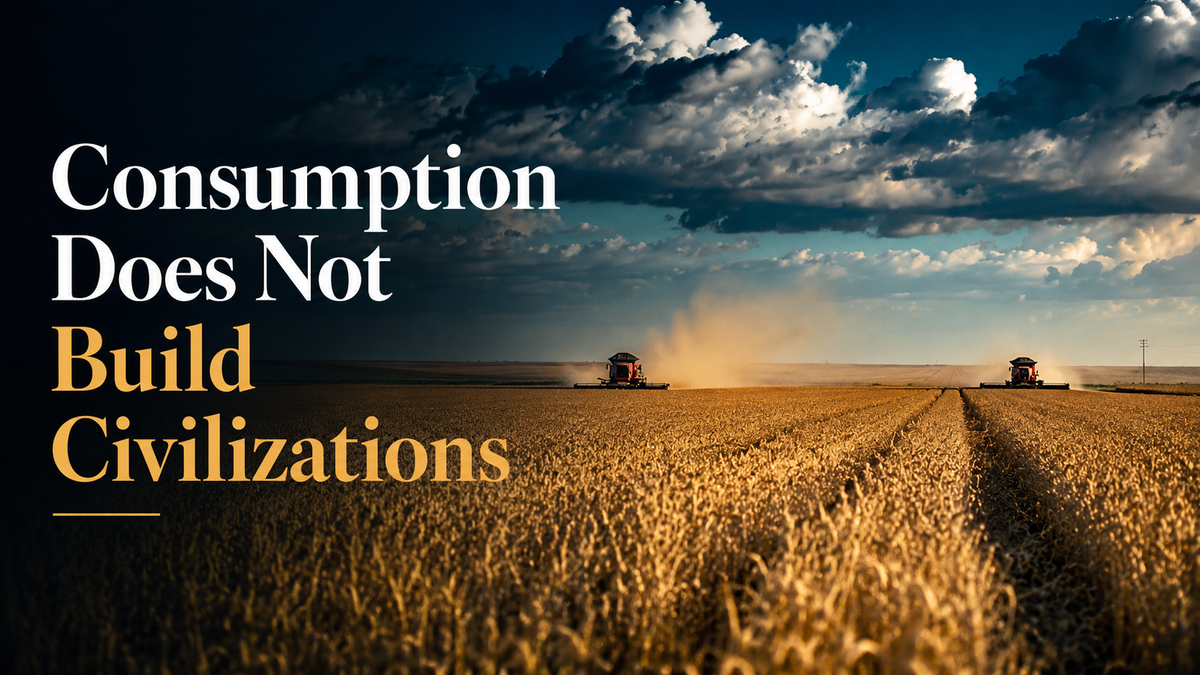
Consumption Does Not Build Civilizations
Consumption creates activity, but production creates strength. Societies sustain long-term resilience when productive systems remain strong enough to support continuity through changing economic conditions.

Modern economies often celebrate consumption as a sign of success.
Higher spending.
More convenience.
More access.
More financial activity.
Consumption can create economic momentum in the short term. It supports commerce, drives demand and contributes to growth across many sectors of the economy.
But civilizations are not ultimately sustained by consumption alone.
They are sustained by production.
This distinction matters more than many societies realize.
A nation consuming more than it produces over extended periods eventually becomes increasingly dependent on external systems for stability. Over time, this weakens resilience because productive capacity gradually deteriorates beneath the surface while dependency expands.
Consumption creates activity.
Production creates strength.
Strong societies usually maintain productive systems capable of sustaining:
- agriculture
- manufacturing
- energy generation
- infrastructure development
- logistics coordination
- industrial processing
- technological capability
These sectors create long-term resilience because they strengthen the foundations underneath economic life itself.
Consumption without productive depth often creates fragility.
At first, societies can appear prosperous while productive systems weaken gradually beneath the surface. Imported goods remain available. Financial markets continue functioning. Economic activity appears strong.
But over time, structural dependency increases.
Once production weakens consistently, countries often become increasingly exposed to:
- supply chain disruptions
- external pricing pressure
- industrial decline
- employment instability
- strategic vulnerability
- trade imbalances
This principle applies to individuals as well.
A person focused entirely on consumption without building productive assets, durable skills or long-term capacity may appear successful temporarily while becoming increasingly financially vulnerable over time.
The same applies to businesses.
Companies that prioritize short-term extraction over productive reinvestment often weaken their own long-term resilience. Sustainable organizations usually continue investing in:
- systems
- maintenance
- productive infrastructure
- operational capability
- human capital
- innovation capacity
because production sustains continuity.
Africa faces an important decision in this regard.
The continent possesses:
- strategic minerals
- agricultural opportunity
- industrial potential
- energy resources
- expanding populations
- entrepreneurial talent
But long-term prosperity will depend heavily on whether productive capacity expands locally or whether consumption continues outpacing production across critical sectors.
Resource extraction alone is not enough.
True economic resilience usually requires:
- industrialization
- infrastructure
- manufacturing depth
- energy reliability
- logistics systems
- value addition
- productive institutions
Without these systems, much of Africa’s value may continue leaving the continent before it compounds locally.
This is why productive cultures matter.
Societies that celebrate production, discipline, craftsmanship, infrastructure building and long-term investment often create stronger continuity across generations than societies focused primarily on short-term consumption and financial appearance.
Civilizations become resilient when productive architecture grows stronger than dependency.
The issue is not eliminating consumption.
Healthy economies require both production and consumption.
But sustainable prosperity usually depends on maintaining enough productive strength underneath economic life to preserve sovereignty, resilience and continuity through changing conditions.
Because ultimately, civilisations are not built by what societies consume.
They are built by what societies produce, maintain and strengthen across generations.
Know a founder, investor, or builder who needs to read this?
Forward it. One share builds one legacy.