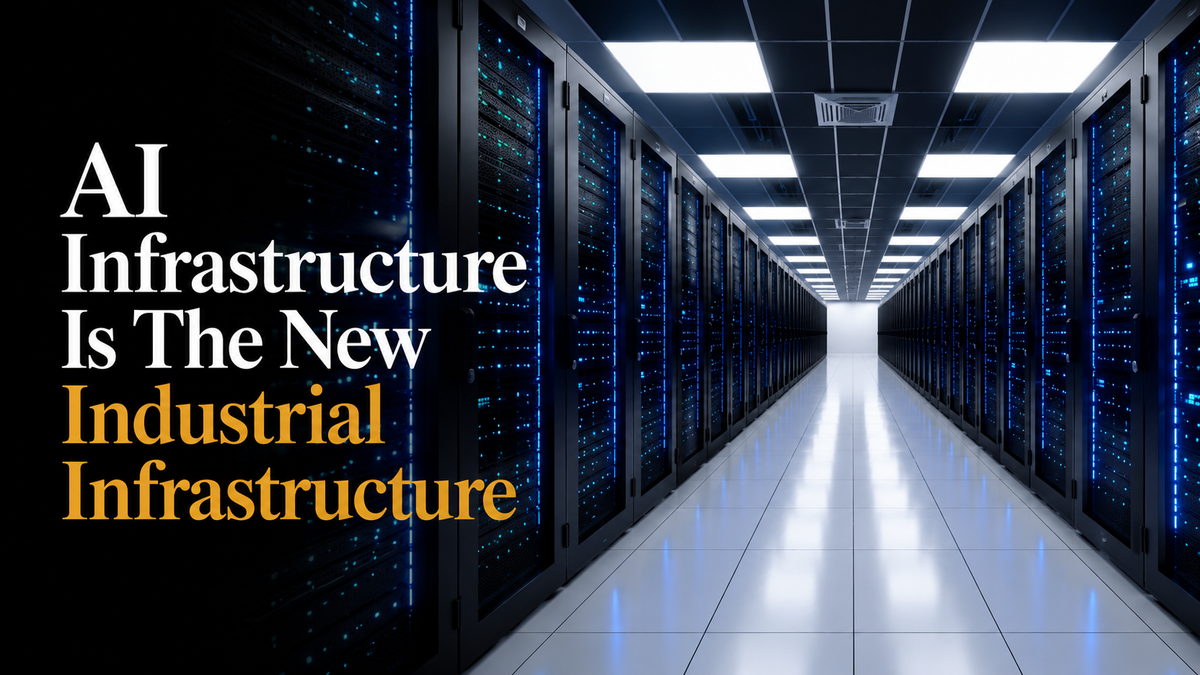
AI Infrastructure Is The New Industrial Infrastructure
Behind every major AI system sits an enormous layer of physical infrastructure supporting its existence. The future of artificial intelligence may depend as much on energy, compute and industrial capacity as on software itself.

Artificial intelligence is often discussed as if it exists primarily in software.
Algorithms.
Applications.
Chatbots.
Automation tools.
But beneath every major AI system sits a vast layer of physical infrastructure supporting its existence.
AI is not weightless.
It depends on:
- data centres
- electricity
- semiconductor manufacturing
- fibre networks
- cooling systems
- cloud infrastructure
- industrial supply chains
- large-scale capital investment
This is why AI infrastructure increasingly resembles industrial infrastructure.
The countries shaping the future of artificial intelligence are not only building software capabilities. They are building the physical systems required to sustain computation at scale.
Compute has become strategic capacity.
Modern AI systems require enormous processing power. Training advanced models consumes significant energy, specialized hardware and data centre capacity operating continuously across highly coordinated infrastructure networks.
Without this infrastructure, AI capability becomes limited regardless of software ambition.
This changes the nature of technological competition.
For decades, many digital businesses could scale rapidly with relatively light physical infrastructure. But large-scale artificial intelligence increasingly depends on industrial-scale systems:
- power generation
- semiconductor access
- fibre connectivity
- cooling infrastructure
- advanced manufacturing
- capital-intensive facilities
This creates a new form of economic concentration around compute capacity itself.
Nations possessing strong digital infrastructure, reliable energy systems and advanced industrial capabilities may gain increasing strategic advantage as AI adoption accelerates globally.
The issue is not simply technological leadership.
It is infrastructure leadership.
This is why data centres matter far more than many people realize.
Data centres are not merely storage facilities for digital services. They are becoming foundational economic infrastructure supporting:
- cloud systems
- AI processing
- digital commerce
- financial systems
- communications infrastructure
- national data capacity
- industrial automation
As economies digitize further, these systems become increasingly essential to national continuity.
Energy now becomes even more important.
AI systems require enormous electricity consumption. As computational demand rises, countries with unstable power infrastructure may struggle to compete effectively in compute-intensive industries.
The future of AI may depend as much on reliable electricity generation as on software development itself.
This is also reshaping geopolitics.
Semiconductor manufacturing, rare earth minerals, energy systems and data infrastructure are becoming increasingly strategic because they influence who controls advanced computational capability.
The AI race is therefore not purely digital.
It is industrial.
It is infrastructural.
It is geopolitical.
Africa should pay close attention to this transition.
The continent possesses:
- critical minerals
- expanding energy potential
- growing digital adoption
- strategic geographic positioning
- rising infrastructure demand
But long-term participation in the AI economy will depend on whether productive digital infrastructure is built locally or whether computational dependency deepens externally.
Digital sovereignty may become one of the defining economic questions of the coming decades.
Countries unable to develop sufficient infrastructure capacity could increasingly depend on external systems for:
- computation
- cloud services
- data storage
- AI capability
- digital coordination
This creates a new layer of strategic vulnerability.
The future will likely belong not only to societies capable of using artificial intelligence, but to societies capable of sustaining the infrastructure underneath it.
Because ultimately, AI is not replacing infrastructure.
It is increasing civilisation’s dependence on it.
Know a founder, investor, or builder who needs to read this?
Forward it. One share builds one legacy.