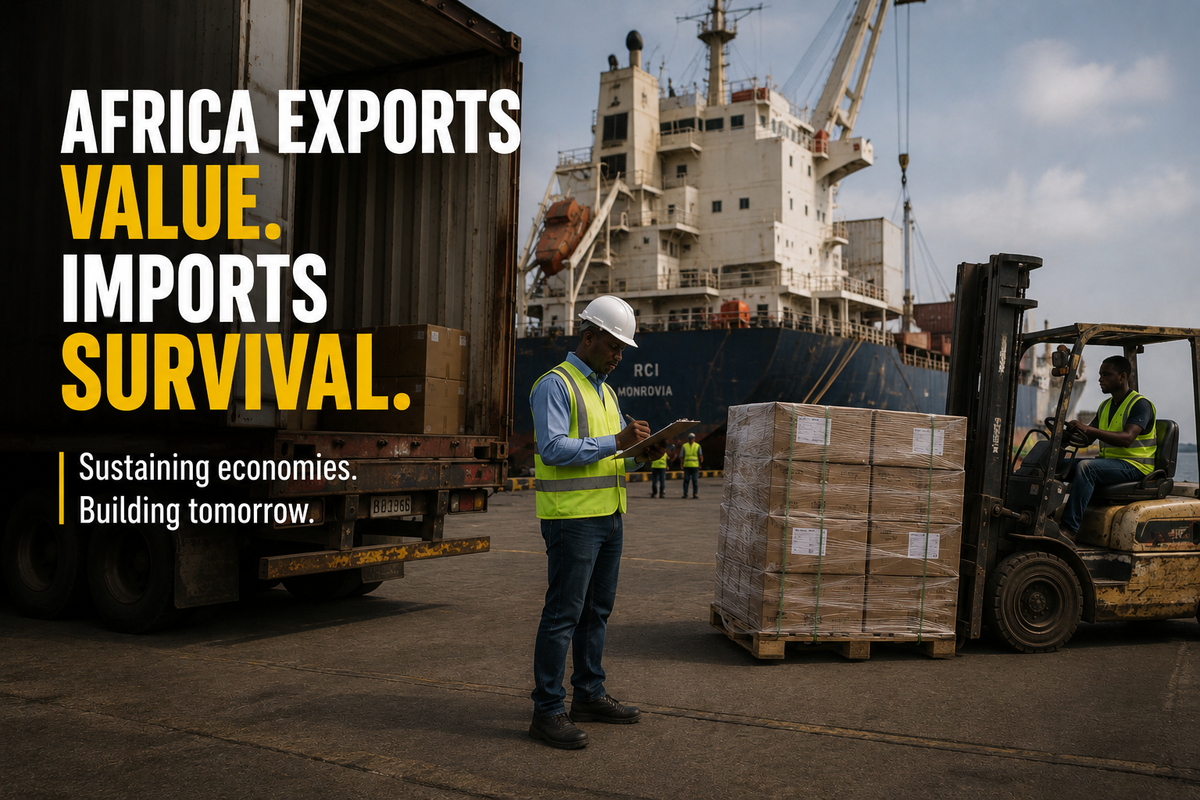
Africa Exports Value and Imports Survival
Nations do not collapse from lack of potential. They collapse when stewardship fails to become structure.

Africa is one of the most resource-rich continents on earth.
It possesses vast mineral reserves, fertile agricultural land, energy potential, strategic trade routes and one of the youngest populations in the world. Yet despite this abundance, much of the continent still imports finished goods, imports food, imports industrial capacity and imports systems that should have been built locally decades ago.
This is one of the great contradictions of modern Africa.
Many nations export raw value while importing survival.
The continent exports:
- minerals
- agricultural commodities
- raw materials
- labour
- opportunity
Yet often imports:
- refined products
- infrastructure
- financing
- manufacturing
- technology
- food systems
- institutional models
This creates a structural imbalance.
Participation alone does not create power.
Ownership does.
A country can participate heavily in global markets and still remain economically vulnerable if it does not control processing, logistics, capital allocation, pricing power or productive infrastructure. Economic activity without ownership eventually concentrates value elsewhere.
This is one of the central development questions facing Africa over the next generation.
Not whether Africa has resources.
The continent clearly does.
The deeper question is whether Africa can increasingly build the systems required to retain more of the value created from those resources.
Because value is not created only at extraction.
Value compounds through:
- processing
- manufacturing
- infrastructure
- logistics
- distribution
- financing
- technology
- intellectual property
- institutional continuity
That is where long-term economic power is built.
A nation exporting raw materials while importing finished products remains trapped in a cycle where the highest-value layers of the economic chain sit elsewhere. Over time, this weakens industrial capability, limits employment depth and increases dependency on external systems.
The same principle applies beyond nations.
Families, businesses and institutions also decline when they consume more structure than they create.
No society can sustainably outsource:
- production
- leadership
- food security
- institutional competence
- capital formation
- long-term planning
without eventually weakening itself.
This is why infrastructure matters.
Not only physical infrastructure such as roads, rail, ports and power generation, but institutional infrastructure:
- leadership
- governance
- productive systems
- financial discipline
- educational quality
- agricultural resilience
- long-term strategic thinking
Economic sovereignty is never built through sentiment alone.
It is built through systems.
Africa’s future will depend heavily on whether the continent can move beyond extraction toward production, ownership and continuity. The nations that succeed over the next several decades will likely be those capable of building durable institutions, productive industries and disciplined capital systems rather than relying solely on commodity cycles.
This also requires a shift in mindset.
For too long, many conversations around development have focused primarily on external solutions while underestimating the importance of internal structure, stewardship and institutional continuity. Foreign investment can assist growth, but no outside force can permanently compensate for weak systems, weak leadership or the absence of productive infrastructure.
Nations rise when responsibility, production and long-term thinking become cultural priorities.
Africa does not lack potential.
It does not lack intelligence.
It does not lack resources.
It does not lack ambition.
What the continent often lacks is alignment between vision, structure, capital and continuity.
The future of Africa will not be secured by extraction alone.
It will be shaped by those capable of building systems that allow value to remain, compound and strengthen societies across generations.
Because the strongest economies are not merely those that export resources.
They are those that build institutions capable of transforming resources into enduring prosperity.
And ultimately, legacy is never built through consumption alone.
It is built through stewardship, ownership and the courage to create systems that outlive us.