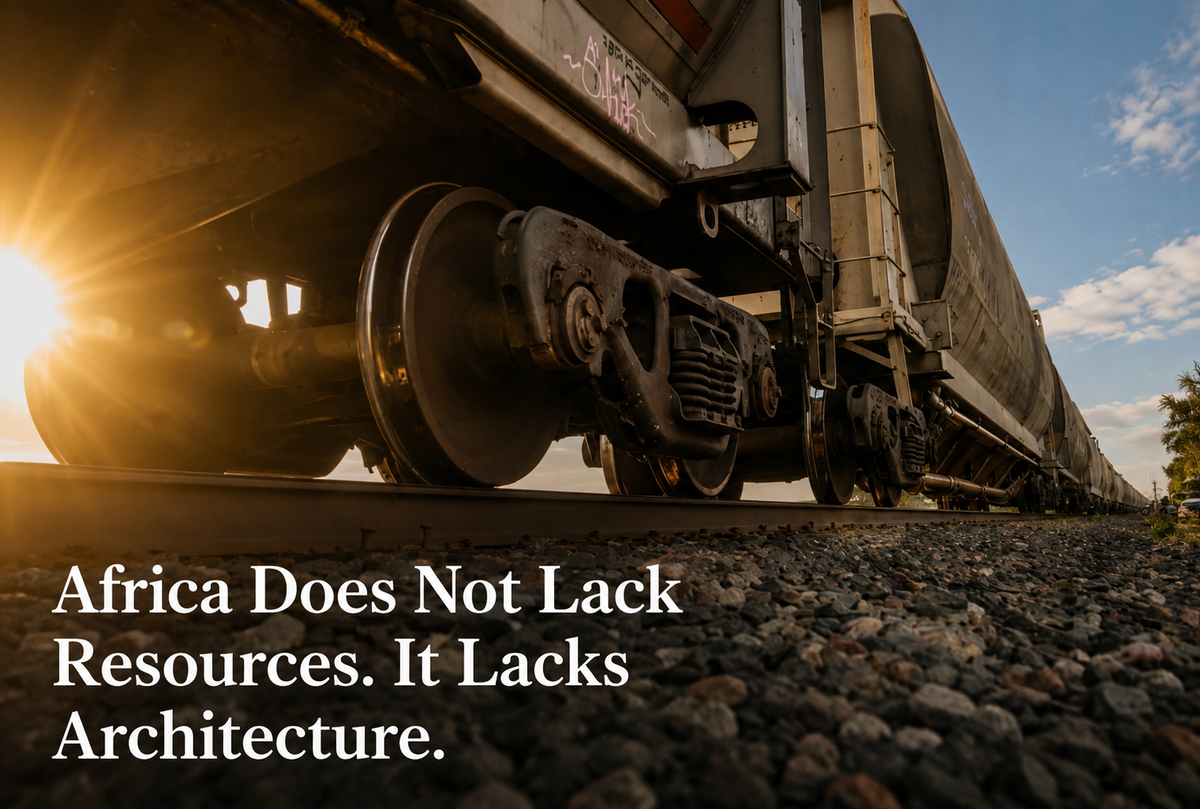
Africa Does Not Lack Resources. It Lacks Architecture.
Resources create potential, but systems determine whether that potential compounds into lasting prosperity. Africa’s greatest challenge is not the absence of resources, but the absence of strong economic, institutional and productive architecture.

Africa is often described as a continent rich in resources.
And that is true.
The continent possesses enormous mineral wealth, fertile agricultural land, strategic trade routes, energy potential and one of the youngest populations in the world. Yet despite these advantages, many African economies still struggle with instability, weak infrastructure, limited industrial capacity and high dependency on external systems.
This contradiction is frequently discussed, but often misunderstood.
The problem is not simply resources.
The deeper issue is architecture.
Resources create potential.
Architecture determines whether that potential compounds into lasting prosperity.
Without strong systems, even extraordinary abundance becomes fragile.
This pattern is visible across history.
Many nations rich in natural wealth have remained economically vulnerable because they lacked:
- institutional continuity
- productive infrastructure
- disciplined governance
- long-term capital allocation
- industrial strategy
- reliable energy systems
- transportation networks
- educational quality
- coordinated development
Resources alone do not create strong economies.
Systems do.
Oil alone does not build nations.
Minerals alone do not create resilience.
Agricultural potential alone does not guarantee food security.
Everything depends on the structures surrounding production.
Architecture is what transforms raw potential into continuity.
It includes:
- roads
- rail
- ports
- energy
- logistics
- education
- governance
- financial systems
- industrial capability
- institutional trust
But architecture is not only physical.
It is also cultural.
Nations are shaped by the quality of:
- leadership
- stewardship
- discipline
- long-term thinking
- institutional integrity
- productive habits
Without these foundations, development becomes inconsistent and vulnerable to disruption.
This is one of the reasons many African economies still export raw materials while importing finished goods, industrial capacity and critical infrastructure. Too much value leaves the continent before higher-value systems are built locally.
Extraction without industrial architecture limits long-term compounding.
The strongest economies in history did not rise because they possessed resources alone. They rose because they built systems capable of:
- processing value
- retaining value
- scaling production
- protecting institutions
- coordinating infrastructure
- strengthening productive capacity over decades
Architecture creates continuity.
This is why infrastructure should never be viewed merely as construction projects. Infrastructure is economic strategy. It shapes trade efficiency, productivity, investment confidence and long-term national competitiveness.
Weak infrastructure increases friction throughout the entire economy.
Reliable systems reduce friction.
This principle applies beyond governments.
Businesses also fail when growth outpaces operational structure.
Families decline when stewardship disappears.
Institutions weaken when governance erodes.
Without architecture, scale becomes unstable.
Africa’s future will not be determined only by the quantity of its resources, but by the quality of the systems built around them. The nations that succeed over the coming decades will likely be those capable of strengthening:
- productive infrastructure
- institutional trust
- energy reliability
- agricultural resilience
- educational quality
- capital systems
- long-term strategic planning
Because ultimately, development is not sustained through extraction alone.
It is sustained through architecture capable of preserving, multiplying and directing value productively across generations.
Africa does not lack potential.
It does not lack resources.
What it often lacks is the coordinated structure required to convert potential into continuity.
And without architecture, even abundance struggles to endure.
If this resonated — you belong here.
Subscribe to The Legacy Times at legacytimes.news
Know a founder, investor, or builder who needs to read this?
Forward it. One share builds one legacy.